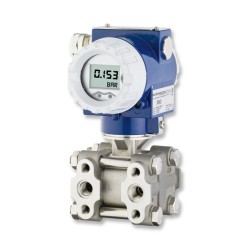
 Differential pressure sensor product selection guide for sensors used to measure the difference in pressure between two points.
Use this product guide for differential pressure sensors to help you choose the most suitable product for your application, understand the purpose of the components that make up a differential pressure sensor and the terminology used when choosing a specification.
Specifying Differential Pressure Sensors
Differential pressure measurement can be one of the most complex and confusing applications when it comes to choosing the right pressure sensor.
Wet & Dry Applications
There are three basic styles of differential pressure sensor when considering media compatibility with liquids, and each one has advantages and disadvantages when compared to the other:
Wet/Wet
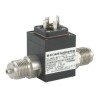 Suitable for liquids on both sides, higher cost, larger size, limited low pressure performance, higher line pressure rating.
Wet/Dry
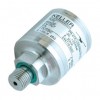 Suitable for liquids on the positive side only, lower cost, greater line pressure and temperature sensitivity, limited range for negative pressure.
Dry/Dry
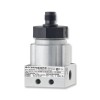 Not suitable for liquids, lower cost, better low pressure performance, lower line pressure rating.
Line Pressure
The line pressure is the the total system pressure, usually this would be the maximum positive side pressure, with the negative side being slightly lower due to a flow restriction between the two sides. the differential pressure is the difference between the positive and negative pressure.
Often the line pressure is much higher than the differential pressure and therefore it is important to check that the sensor has a sufficient line pressure rating before assessing whether the differential pressure range is suitable.
It is also important to know whether the sensor will tolerate the line pressure on both sides or only one side, since if the right precautions are not taken it is very easy to accidentally apply full line pressure to one side during installation or maintenance, and thus damage the sensor.
The line pressure is an indicator of the mechanical integrity of all materials, welds and seals used in the construction of the transmitter.
Some processes have a varying line pressure which means that the stress on the mechanical structure of each side of the differential pressure transducer is going to change. If a differential pressure cell or dp cell has not been mechanically designed to balance these stresses equally on both sides, a change in line pressure will result in a zero shift offset in the output signal. This is because the sensing diaphragm is coupled to the surrounding components and will be sensitive to any imbalance in stress causing a slight diaphragm deflection.
Some manufacturers will include information about how performance is affected by changes in line pressure on the product specification data sheet.
Over-Pressure
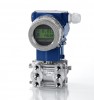 This is the highest permissible pressure difference without damaging functionality or integrity of the transmitter. Some overpressure specifications will also include a “no effect on performance” statement. Some overpressure ratings are directional, typically the positive overpressure rating will be higher than the negative side.
Since you are often measuring a differential pressure that is lower than the system line pressure there maybe a high risk of differential over-pressure which can put a sensor out of calibration or out of service permanently.
If the application has the potential for high over-load differential pressures on one side then look for a differential pressure transducer which incorporates mechanical diaphragm stops or if the differential pressure is relatively high compared to the static line pressure consider a differential pressure transmitter that uses two absolute pressure sensors instead.
Oil Filled Thermal Effects
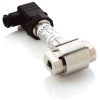 Some differential pressure transmitters use oil filled capsules with thin isolation membranes on both sides of the sensing diaphragm. As the temperature increases or decreases the oil will expand and contract and this will be sensed by the diaphragm. If the oil volume on both sides are equal and the isolation membranes on both sides are identical then the net effect will be greatly reduced because the effect on one side will cancel the effect on the other side.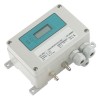
So called dry cell differential pressure transmitters do not have oil filled cells and thus do not exhibit thermal errors associated with oil expansion. However, like all types of electro-mechanical pressure sensors they are not completely immune to thermal errors, since the sensing technology and the mechanical construction will still react to changes in temperature.
To combat these issues with differential pressure measurement, some manufacturers have incorporated features to protect differential pressure sensors and improve on their performance.
If the operating temperature varies over a wide range, check the thermal error quoted on the product data sheet particularly the thermal zero errors. When checking the accuracy of a pressure sensor on the product data sheet of any kind, it is important to understand what the accuracy statement includes, since many will only include the accuracy at room temperature and you have to look elsewhere on the data sheet to find the errors associated with a temperature change.
Mechanical Stops
This is a feature incorporated into the mechanical assembly of a dp cell pressure transmitter which protects sensitive components from a significant overpressure condition. The mechanical stop is typically a metal face positioned behind a diaphragm. If an overpressure limit is exceeded the diaphragm will butt up against the mechanical stop which will prevent it from traveling too far. A mechanical stop will normally be incorporated on both sides of the sensing diaphragm to protect the transmitter from an overload condition in either direction. This is particularly useful for installations where there is the risk of accidentally disconnecting one side of the differential pressure transmitter.
Square Root Extraction Output
Differential pressure sensors are often used to indirectly measure flow. The relationship of flow to differential pressure is a square root function. In order to improve resolution at the lower end of the pressure range where there is a larger change in flow, a square root extraction dp sensor will provide a modified output which is linear with flow rather than pressure.
Bi-directional Pressure Range
The output signal of a bi-directional differential pressure sensor is scaled over a pressure range which can vary by an equal amount in the positive and negative direction, e.g. -15 to +15 mbar = 0 to 10 Volts dc. Bi-directional pressure ranges are used in applications such monitoring the ventilation flow pressure in a duct, to monitor pressure difference between rooms.
DP Cell
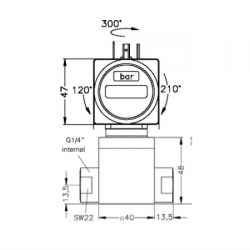
 A DP Cell is a type of differential pressure sensor which consists of two oil filled chambers separated by a single sensing element.
Each oil-filled chamber includes a membrane which allows the oil to be pressurized externally. If the oil pressure is greater on one side than the other it will cause the sensing element to flex slightly, which will generate a change in signal output proportional to the pressure difference.
DP Cells are built into differential pressure transmitters which are commonly used by the process control industry. A process dp transmitter consists of three main components which include the DP Cell, mounting flange and electronics housing. The DP Cell is bolted between two mounting flanges which provide the mechanical interface to each isolation diaphragm. Since the mechanical assembly is bolted together it is possible to replace the DP Cell during its service life.
A DP Cell will often include an internal mechanical feature which protects the central sensing element from damage caused by high overpressure on one side of the DP Cell. This high overpressure feature is often called a Mechanical Stop because it limits the travel of the isolation diaphragm on either side of the DP Cell.
Inside a Differential Pressure Sensor
Explanatory video of how a typical process differential pressure transmitter works.
This overview of the workings of a DP cell, guides you through the various mechanical components such as the functional purpose of the process isolation diaphragms, the oil fill and the capacitance sensing element.
Installing Differential Pressure Sensors
Pipe connections
Length each side
Different lengths of connecting pipe on the positive and negative side might introduce an imbalance in the response to differential pressure change between high & low side. How much this will affect readings will depend on the inside diameter, inside surface smoothness and length of each connecting pipe, viscosity of the fluid, and the dynamic response of the sensor.
Flexible pipes
If there is a lot of flexibility in the connecting pipes this will introduce a damping effect to changes in pressure. This effect will be most noticeable if you need to take measurement readings at a high frequency rate.
Long pipes
The longer the overall length of connecting pipes, the more likely there will be a lag in response to changes in pressure. Small inside diameter in proportion to the overall length, rough surface finish and denser media, will amplify this effect.
Trapped air when measuring liquids
Any trapped air in the lines may cause a damping effect, slow the response time, and generate a slight increase or decrease in pressure due to adiabatic effects caused by changes in temperature. Incorporating bleed valves close to the points where air could be trapped, will allow you vent it off as the connections are filled with fluid.
Overpressure precautions
If the differential pressure sensor cannot withstand full line pressure on one side only, then consider adding isolation/block valves for the high & low side and a bypass valve between the high & low side to equalise the isolated pressure on both sides. This block & bleed valve arrangement will allow you to service a differential pressure sensor in-situ without accidentally over-pressurising the sensor on one side.
Measuring Flow
How a differential pressure transmitter is used to measure the flow of a gas or liquid in a closed pipe.
This video guide explains the different types of primary elements used to measure flow and how they produce a differential pressure which can then be converted to a linear measurement of flow from calculating the square root of the pressure. It also covers the ways to install a DP transmitter on different types of media flow.
Product Help
High pressure DP
Our supplier claimed that a 400 bar capsule for differential pressure measurement is not possible, no brands can meet this type of process unless special design. Is this statement is correct?
Yes, most types DP sensors are not designed to measure a high differential pressure. This is mainly because it is simpler and lower cost to use 2 separate high pressure sensors and subtract the two signals to determine the DP measurement without too much degradation in accuracy.
Differential pressure sensors are normally much more expensive, heavier and larger in size than devices designed to measure gauge or absolute referenced pressure on one port connection. But they are the ideal choice when the difference in pressure is small compared to the base pressure (static line pressure), since maintaining a good accuracy by subtracting the output of two sensors becomes impractical.
Differential range dry
What is the meaning if a pressure sensor is described as having a differential range dry?
If the pressure sensor is described as being dry, it can mean one of two things:
- The sensor technology used has no internal fluid fill, typically contained behind an isolation diaphragm and referred to as a dry cell.
- Only dry or non-condensing gas can be measured by the differential pressure sensor e.g. wet/dry would allow liquids on the positive side but only dry gases on the negative side. dry/dry would mean no liquids allowed on both pressure ports of a differential pressure sensor.
The DPS is a dry cell differential pressure sensor which has no liquid filled components.
The DMD341 is a dry/dry differential pressure sensor which should not be used to measure the pressure of liquids.
A list of queries and explanations relating to the selection of specification parameters for differential pressure transducers and transmitters.
Measuring suction pressure
Can Differential Pressure Sensors be used for measuring Suction Pressure?
Yes, if the sensor has a positive range connect the negative side port to the suction pressure and leave the positive port open to ambient air pressure.
Static line pressure & differential pressure
What is the difference between static pressure and differential Pressure?
“Static Pressure” or “Static Line Pressure” refers to the pressure at one point on a system, vessel or pipe. Typically it is used to define the highest pressure point on a system around the measurement point.
Differential Pressure is the pressure measured between 2 separate measurement points, typically these 2 points are located on the same system where a high and low pressure region is generated due to a restriction in flow of gas or liquid.
It is important to define the maximum static line pressure in order to ensure that a differential pressure sensing device can withstand being pressurised to the maximum static line pressure on both ports without damage or mechanical failure. Some devices such as DP cells are designed to withstand the maximum static line pressure on one port only, which protects the DP cell from accidental overload on one side.
For example consider a 1 cm diameter pipe 10 metres long filled with water pressurised to a pressure of 10 bar by a pump at one end, and a valve slightly open at the other end allowing the water to flow through the pipe. The pressure measured at the valve reads 9 bar and at the pump it measures 10 bar. In this example the static line pressure is 10 bar and the differential pressure between the pump and valve is 1 bar.
Measuring gauge reference pressure using dp sensor
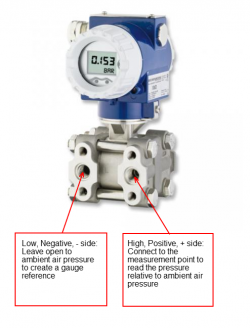 I need to measure a pressure from -10 to +10 psi which is referred to ambient atmospheric pressure. Is it possible to use a differential pressure sensor instead of a gauge reference pressure sensor, with the positive side connected to the media and the negative side vented to the ambient atmospheric pressure?
Yes, this will work, a gauge reference sensor is one that is referenced to ambient air pressure via a vent tube which is connected from the negative side of the sensing diaphragm to the outside environment, e.g. through the signal cable or a hole beside the electrical connector. So by leaving the negative side port of the differential pressure sensor vented to atmosphere, you are in effect, creating a gauge reference pressure sensor.
Using dp range to measure suction pressure
Can a differential range be used for measuring suction pressure?
Yes, there are two ways of using differential pressure sensing instruments (DP) for measuring suction pressure:
- Leave the negative side port open to atmosphere and connect the positive side to the suction pressure. The DP should be scaled and calibrated to read in the negative direction.
- Leave the positive side open to atmosphere and connect the negative side to the suction pressure so that the DP will measure the difference as if it were a positive pressure.
Will venting a DP sensor on one side cause damage
I have a question regarding differential pressure transmitter, If one side, such as the low pressure side of the transmitter has zero pressure, can the transmitter be damaged by this?
Yes, but it depends on what pressure is on the high side and the differential overload rating capability of the transmitter.
For example if you have 1 psi differential range with a line pressure of 150 psi, then potentially you will have 150 psi differential on the high side if you have zero pressure on the low side. Unless the differential pressure transmitter has in-built mechanical pressure stops, to protect the sensor from a 150 psi pressure on one side only, it will most likely damage the sensing diaphragm because it is only rated to 1 psi differential.
How does reversing differential pressure affect output signal
If the high side of a differential pressure transmitter has a lower pressure than the low side, will it have an output?
If the differential pressure transmitter has been set up to measure only over the positive range then the output will bottom out just below 4 mA if it is a 4-20mA output device or at the lowest voltage output if it is a 3 wire configure voltage output device. Most differential pressure transmitters are capable of measuring the pressure in the negative or reverse direction, but the signal conditioning electronics is not always configured to do this.
Each manufacturer has a different approach to re-ranging differential pressure transmitters, some may offer it as a factory only fixed setting option and others may provide a way for the user to configure it themselves. Most intelligent differential pressure transmitters will allow the user to configure the output signal for a negative range or both negative and positive ranges combined. This is typically carried out by suppressing the zero output to the required negative value, and if necessary reducing the span within the turn-down range capability of the device, to the required full scale output.
Flow indicator setting with sqrt input
If dp transmitter has a square root output and I want to connect its o/p to a flow indicator then what will be the setting in the flow indicator, sqrt or linear?
You would use the flow indicator in linear mode if the dp transmitter was connected to a closed pipe and generating a sqrt output.
HEPA & MERV filter replacement warning
 I have an Exair 6083 vacuum pump that is feeding into a HEPA filter and then through a MERV filter. I want a dp sensor which will also display the pressure and send a switch signal when the filters need to be replaced.
We would suggest a DMD341 if the dp pressure is very low, or the DMD331 if the dp pressure is high, these will provide the analogue output. For the display and switch signal output we would suggest the PA430 which can be mounted on top of either dp sensor and display the pressure drop across the HEPA or the MERV filter.
Clocking error
Can you explain the clocking error indicated on some differential pressure transmitter data sheets?
It relates to the synchronisation error when subtracting the signals from two pressure sensing elements to calculate the differential pressure.
Checklist for differential pressure sensor requirements
Define your differential pressure sensor requirements using this checklist:
- Differential pressure range?
- Static line pressure?
- Overpressure?
- Media type?
- Media temperature range?
- Environmental conditions?
- Signal output?
- Power supply?
- Measurement accuracy?
- Electrical connection?
- Process connection?
- Certification?
Featured Differential Pressure Sensor Product Types
Select a differential pressure sensor type from the list below to view detail product information and request a quote.
- Differential Pressure Transmitters - Differential pressure transmitters for measuring the DP of fluids and gases across particle filters and along a length of pipe to monitor flow.
 Low Differential Pressure Transmitters - Low differential pressure transmitters for measuring small pressure differences between two measurement points on across ventilation fans, air filters or clean room walls.
Related Help Guides
- Measuring the difference in air pressure between rooms
- Measuring negative pressure using a positive differential pressure range
- What can a DP sensor be used to measure beyond differential pressure?
- How do you measure flow rate with a dp cell
- Measuring flow rate of a liquid or gas using a dp sensor
- Measuring density of a liquid using a dp sensor
- Measuring liquid level in a tank using a dp sensor
- Measuring gauge pressure using a dp sensor
- Measuring absolute pressure using a dp sensor
- Measuring barometric pressure using a dp sensor
- Measuring vacuum as an absolute range using a dp sensor
- Measuring vacuum as a negative gauge pressure using a dp sensor
- Measuring liquid level in a sealed tank with a hydrostatic pressure sensor
- What does the suffix a, abs, d, dp and diff, g, rel and sg mean after the pressure units in a pressure range?