
Inch of Mercury is a British and American unit of measure for pressure. 1 inch of mercury at 0 degrees Celsius (32 deg F) equals 3386.39 pascals. An inch of mercury at zero degrees Celsius is defined as the pressure exerted by a column of mercury with a density of 13,595.1 kg/m3 under the pull of gravity at 9.80665 m/s2.
The inHg pressure unit is not used so extensively in the UK anymore and has been mostly replaced by the metric units mmHg and mbar. However, inches of Mercury are still used extensively in the USA particularly for meteorological purposes when measuring atmospheric pressure.
Mercury has a very high density which made it a very practical liquid for use inside fluid filled columns for measuring pressure in the laboratory. However Mercury is now considered a hazardous substance and mercury manometers have been almost totally eliminated from laboratories for health and safety reasons.
Use the following conversion factors to convert from inHg to other pressure units or vice versa. To convert a reading in inHg to another unit multiply it by the relevant pressure conversion factor. To convert a reading in any pressure unit to inHg divide it by the relevant pressure conversion factor.
Alternatively convert from a inHg pressure value into another unit using the pressure unit converter.
Read how inHg is derived from SI units or verify a pressure unit is one of the various forms used for inHg.
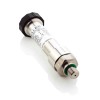 Barometric transducer with 23-34 inHg input range and 0-5Vdc output range
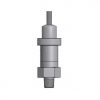 -2 to 2 inHg g 4-20mA out intake and exhaust air pressure sensor for building management use
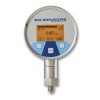 30 inHg low relative vacuum range digital display vacuum pressure gauge and logger
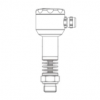 Minus 30 inHg 4-20mA air pressure sensor for measuring vacuum in a sealed tank heated to 350F
Conversion Factors
- 0.0338639 bar
- 0.491154 psi
- 33.8639 mbar
- 3386.39 N/m²
- 3386.39 Pa
- 33.8639 hPa
- 3.38639 kPa
- 0.00338639 MPa
- 0.0345315 kg/cm²
- 345.315 mmH2O 4°C (39.2°F)
- 34.5315 cmH2O 4°C (39.2°F)
- 0.345315 mH2O 4°C (39.2°F)
- 13.5951 inH2O 4°C (39.2°F)
- 1.13292 ftH2O 4°C (39.2°F)
- 25.4000 mmHg 0°C (32°F)
- 2.54000 cmHg 0°C (32°F)
- 1 inHg 0°C (32°F)25.4000 Torr
- 25400 mTorr
- 0.0334211 atm
- 0.0345315 at
- 33863.9 dyn/cm²
- 7.85847 oz/in²25400.0 µHg 0°C (32°F)
- 0.000219265 tsi (uk, long)
- 0.000245577 tsi (usa, short)
- 0.0353631 tsf (usa, short)
- 70.7262 psf
- 34.5315 g/cm²
Please note that the conversion factors above are accurate to 6 significant figures.
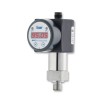 Negative 30 inHg vacuum gauge with 0-10V output
- Barometric transducer with 23-34 inHg input range and 0-5Vdc output range
- 30 inHg absolute RS232 output vacuum range pressure sensor
- 30 inHg low relative vacuum range digital display vacuum pressure gauge and logger
Derivation
The calculation below shows how the pressure unit inches of mercury (inHg) is derived from SI Units.
Formula
- Pressure = Force / Area
- Force = Mass x Acceleration
- Mass = Density x Volume
- Volume = Area x Height
- Acceleration = Distance / (Time x Time)
SI Units
- Mass: kilogram (kg)
- Distance: metre (m)
- Time: second (s)
- Force: newton (N)
- Pressure: pascal (Pa)
Input Values
- Density = Mercury Density at 0degC = 13595.1 kg/m³
- Area = 1 m²
- Height = 1 in = 0.0254 m
- Acceleration = Standard Gravity = 9.80665 m/s²
Calculation
- 1 inHg Mass = 13595.1 kg/m³ x 1 m² x 0.0254 m = 345.31554 kg
- 1 inHg Force = 345.31554 kg x 9.80665 m/s² = 3386.38864 N
- 1 inHg Pressure = 3386.38864 N / 1 m² = 3386.38864 Pa
- -2 to 2 inHg g 4-20mA out intake and exhaust air pressure sensor for building management use
- Negative 30 inHg vacuum gauge with 0-10V output
- Barometric transducer with 23-34 inHg input range and 0-5Vdc output range
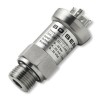 23 to 33 inHg barometric range pressure transducer with a 10 volt hi-resolution output
Alternate Descriptions
These are the different versions used for identifying inHg that you may find elsewhere.
- Inches of Mercury
- Inch of Mercury
- Inches of Mercury Column
- Inch of Mercury Column
- inHg
- in Hg
- “Hg
- ” Hg
Conversion Tables
Select a look up table for converting a pressure reading in inches of mercury column to other measurement units.
- bar » 0.01 to 40.00 inHg → 0.000338639 to 1.35456 bar
- psi » 0.01 to 40.00 inHg → 0.00491154 to 19.6462 psi
- mbar » 0.01 to 40.00 inHg → 0.338639 to 1,354.56 mbar
- mmHg » 0.01 to 40.00 inHg → 0.254 to 1,016.00 mmHg
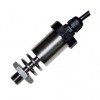 Vacuum and steamer pressure transducer with -30 inHg to 100 psi range
- -2 to 2 inHg g 4-20mA out intake and exhaust air pressure sensor for building management use
- 23 to 33 inHg barometric range pressure transducer with a 10 volt hi-resolution output
- Negative 30 inHg vacuum gauge with 0-10V output
Help
Should liquid temperature be considered when using inHg units
How can I convert mbars to inHg when the prevailing temperature at the time of measurement was 91 degrees F? I see your table answers this question for 32 degrees F. Does the inHg unit change with a higher ambient temperature?
The temperature is mentioned in the inHg units because a 1 inch column of Mercury will generate a different pressure depending on the temperature of the mercury column. This is because thermal expansion causes a change in density. Today the inHg pressure unit is mostly converted electronically within the instrumentation without the need to use an actual liquid Mercury column. So the temperature provides a reference for the density of liquid Mercury that should be used when converting to other pressure units, and is unrelated to the actual temperature of the gas or liquid being measured.
It is usual to specify the reference temperature when using inHg pressure units, 32 degF (0 degC) is often used but there are other conventions such as 60 degF (15.56 degC). The difference in density between Mercury at 32 degF and 60 degF is about 0.3%, so if you are looking to provide a precise conversion to inHg it is important to quote the reference temperature alongside the inHg unit.
So unless you are measuring the pressure directly using a ‘real’ Mercury column manometer and the mercury inside is at an ambient temperature of 91 degF, there is no need to convert the inHg units you are using to a different temperature.
The variation in Mercury density at different temperatures is one of the main reasons the National Physical Laboratory (NPL) in the UK discourages the use of manometric units such as inHg, so they are best avoided, especially if you are measuring to a high precision. When you consider that inHg pressure units are often quoted without any mention of the temperature reference, the margin for error becomes even greater.
- 23 to 33 inHg barometric range pressure transducer with a 10 volt hi-resolution output
- Vacuum and steamer pressure transducer with -30 inHg to 100 psi range
- 30 inHg low relative vacuum range digital display vacuum pressure gauge and logger
- Minus 30 inHg 4-20mA air pressure sensor for measuring vacuum in a sealed tank heated to 350F