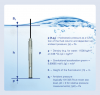
Meters of water gauge or column is a metric unit for measuring liquid level. 1 metre of water column at 4 degrees celsius equals 9806.65 pascals.
The hydrostatic pressure generated by a certain liquid level is typically represented by the equivalent height of a water column.
Since the pressure exerted by one metre of water is dependent on its density and the local gravity it is not a fundamental unit of measure for pressure but a derived one which is called a manometric unit.
Metres of water column or water gauge are used throughout the world but mostly in Europe to measure the level of fresh water in boreholes, rivers and reservoirs.
Metres of water pressure units are expressed in mostly three different ways which are metres of H2O (mH2O), metres of water gauge (mWG) or metres of water column (mWC).
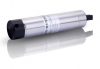 40m RS485 Modbus RTU submersible borehole pump drawdown depth sensor
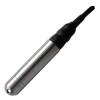 3 metre range submersible freshwater level transmitter
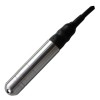 Fresh water compatible submersible 1mH2O range 4-20mA output pressure sensor
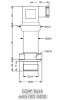 10 metre high vegetable oil level transducer with 0 to 10 volt output
Since the density of a liquid is affected by changes in temperature, metres of water column should be accompanied by the temperature of the liquid that the units were derived. A pure water density of 1000 kg/m3 at 4 deg C and standard gravity of 9.80665 m/s2 is used in the calculation of this pressure unit. The significance of 4 degrees Celsius (39.2 degrees Fahrenheit) is that it is very close to the temperature that water reaches its maximum density.
It is conventional practice to use 1000 kg/m3 as the density of pure water at 4 deg C which is very close to the precise density and for most measurements this does not introduce any significant error. In fact since the temperature can vary significantly, measuring pressure in metres of water is never going to be a precise representation of the true liquid height. Local gravity also varies at different geological locations, which also adds some minor uncertainties to the use of metres of water gauge as an indication of exact water level in different parts of the world.
Use the conversion factors in the table below to convert from mH2O to other pressure units.
To convert a reading in any pressure unit to mH2O click on the relevant pressure conversion factor below and multiply by the conversion factor for mH2O.
Alternatively convert from a mH2O pressure value into another unit using the pressure unit converter.
Find out how the value for mH2O is determined from SI units or check the different ways of identifying mH2O.
 0…100 metres Liquid Level Range Sensor with 4-20mA Current Output Signal Transmitter
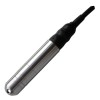 Immersible water level sensor for 4 metre deep cold water storage tank
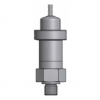 5 metre range high accuracy 4-20mA output non-corrosive liquid level sensor with G1/4 male external fitting
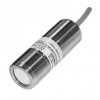 6m range 4-20mA submersible animal feed tank level and PT100 sensor
Conversion Factors
- 0.0980665 bar
- 1.42229 psi
- 98.0665 mbar
- 9806.65 N/m²
- 9806.65 Pa
- 98.0665 hPa
- 9.80665 kPa
- 0.00980665 MPa
- 0.1 kg/cm²
- 1000 mmH2O 4°C (39.2°F)
- 100 cmH2O 4°C (39.2°F)
- 1mH2O 4°C (39.2°F)
- 39.3701 inH2O 4°C (39.2°F)
- 3.28084 ftH2O 4°C (39.2°F)
- 73.5539 mmHg 0°C (32°F)
- 7.35539 cmHg 0°C (32°F)
- 2.89590 inHg 0°C (32°F)
- 73.5559 Torr
- 73555.9 mTorr
- 0.0967841 atm
- 0.1 at
- 98066.5 dyn/cm²
- 22.7573 oz/in²
- 73555.9 µHg 0°C (32°F)
- 0.000634971 tsi (uk, long)
- 0.000711167 tsi (usa, short)
- 0.102408 tsf (usa, short)
- 204.816 psf
- 100 g/cm²
Please note that the conversion factors above are accurate to 6 significant figures.
- Landfill leachate 2.5 mWG range level sensor with 5 volt output
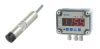 Underground rain water storage tank level sensor and readout for 2 metre depth
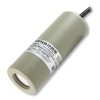 Hydrochloric acid storage tank 1mH2Og hydro-static pressure transmitter
 SDI-12 near shore tide gauge submersible 20m level probe
Derivation
The calculation below shows how the pressure unit Metres of Water Column (mH2O) is derived from SI Units.
Formula
- Pressure = Force / Area
- Force = Mass x Acceleration
- Mass = Density x Volume
- Volume = Area x Height
- Acceleration = Distance / (Time x Time)
SI Units
- Mass: kilogram (kg)
- Length: metre (m)
- Time: second (s)
- Force: newton (N)
- Pressure: pascal (Pa)
Input Values
- Density = Water Density at 4degC = 1000 kg/m³
- Area = 1 m²
- Height = 1 m
- Acceleration = Standard Gravity = 9.80665 m/s²
Calculation
- 1 mH2O Mass = 1000 kg/m³ x 1 m² x 1 m = 1000 kg
- 1 mH2O Force = 1000 kg x 9.80665 m/s² = 9806.65 N
- 1 mH2O Pressure = 9806.65 N / 1 m² = 9806.65 Pa
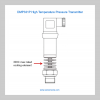 2m tank height, high temperature oil level sensor with 4-20mA out
 Low cost hydrostatic sensor for measuring depth of Diesel up to 2 metres
- Submersible 0.5 metre deep fresh water level sensor
 Borewell water level sensor for 100m water height
Alternate Descriptions
These are the different versions used for identifying mH2O that you may find elsewhere.
- Metres of H2O
- Meters of H2O
- Metres of Water Column
- Meters of Water Column
- Metres of Water Gauge
- Meters of Water Gauge
- mH2O
- mWC
- mWG
- mWS
- mAq
- mCE
- m H2O
- m WC
- m WG
- m WS
- m Aq
- m CE
Conversion Tables
Select a look up table for converting a pressure reading in metres of water column to other measurement units.
- ftH2O, bar, psi and inHg
- ftH2O » 0.1 to 10,000 mH2O → 0.328084 to 32,808.4 ftH2O
- bar » 0.1 to 10,000 mH2O → 0.00980665 to 980.665 bar
- psi » 0.1 to 10,000 mH2O → 0.142233 to 14,223.3 psi
- kPa » 0.1 to 100 mH2O → 0.980665 to 980.665 kPa
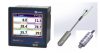 Email notifying multiple 4m high water tanks level controller
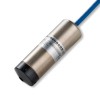 6m deep ballast tank level transmitter with marine certificate
- Remote site 20 mH2O gauge range 0-2.5V low power output submersible water level transducer
- 3m range 4-20mA output submersible seawater dewatering tank level sensor
Help
mVP meaning
We would like to know whether mVP is a different name for metre of water pressure measurement unit. Is it a different description for metre of water in pressure units, and the same conversion of metre of water?
mVP means “metri vesipatsasta” which is Finnish for meter water column, therefore it is the same pressure unit and the abbreviation is derived from the translated unit.
mWS meaning
In a conversion table for pressure units it shows mWS. For example it states 1 mWS = 0.09807 bar and 1000 mWS = 98.0665bar. What is the unit mWS?
It is short for the german equivalent to the pressure generated by a 1 metre high water column. mWS = “Meter Wassersäule” which in english means “Metres of Water Column”.
mCE meaning
What does the mCE unit mean?
“mCE” or “mètre de colonne d’eau” is the French equivalent to “mH2O” or “metres of water column” pressure units.
Converting meters of water absolute into gauge
What is the difference between ‘meters of water gauge’ and ‘meters of water absolute’? Can you convert from one unit to the other?
Any pressure value with ‘gauge’ following the engineering units means that the pressure is referenced to local atmospheric pressure.
Any pressure value with ‘absolute’ following the engineering units means that the pressure is referenced to a perfect vacuum.
In order to convert from one to the other you will need to know the local atmospheric pressure which is constantly changing. Then subtract the atmospheric pressure from the ‘meters of water absolute reading‘ to convert it to meters gauge, or add the atmospheric pressure reading to the ‘meters of water gauge’ reading to convert it to meters absolute .
Remember to use the same units for the two measured readings (e.g. meters of water) when converting the pressure from absolute to gauge or vice versa.
mWG meaning
What does mWG mean?
mWG is the acronym for metres of water gauge. mWG is a measurement unit which relates to the pressure generated by a 1 metre high column of fresh water minus atmospheric pressure acting on the liquid surface. Devices which measure in mWG are used to measure liquid depth or level.
- 5m range 4-20mA output submersible seawater intake channel level sensor
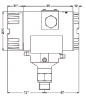 7mH2O hydrostatic level sensor with 4-20mA plus HART
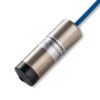 Dockside sea water tide level transmitter up to 6 metres depth
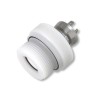 1 metre screw-in plastic level sensor for biodiesel/sulphuric acid mixture with 4 to 20 mA output
Glossary of Liquid Level technical terms
- Capacitive Fluid Level Measurement
- cmH2O – Centimetres of Water Column at 4 deg C Pressure Unit
- Conductive Fluid Level Detection
- Float Fluid Level Detection
- ftH2O – Feet of Water Column at 4 deg C Pressure Unit
- mmH2O – Millimetres of Water Column at 4 deg C Pressure Unit
- Specific Gravity
- Vibrating Tuning Fork Fluid Level Detection
Help from Liquid Level resources
- Measuring the volume of liquid in a horizontal cylinder tank
- Determining water tank volume using hydrostatic pressure
- How do you measure the volume of a liquid using pressure
- Calculating required pressure range for fuel tank level measurement